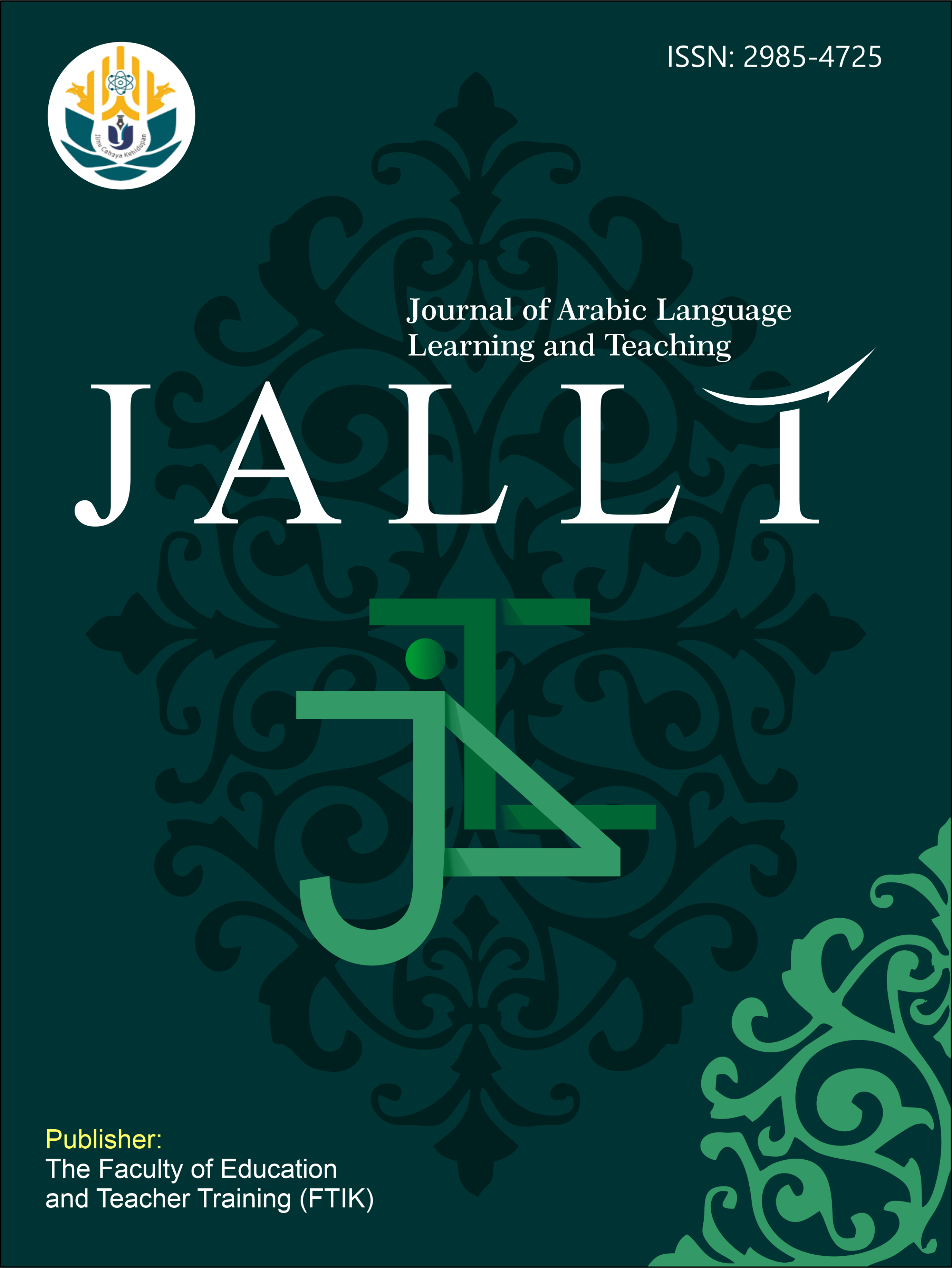
This journal issue presents five scholarly articles contributed by fourteen researchers from diverse academic backgrounds in Arabic linguistics and language pedagogy. The authors represent institutions from Malaysia, Indonesia, and Jordan, highlighting regional and international collaboration in Arabic language research. Malaysian contributors are affiliated with Universiti Teknologi MARA (UiTM), International Islamic University Malaysia, Universiti Malaya, and Maktab Mahmud Yan. Indonesian scholars are associated with Universitas Islam Internasional Darullughah Wadda'wah and Sekolah Tinggi Agama Islam Al-Yasini, while one contributor represents Yarmouk University, Jordan. The articles explore a range of themes, including grammatical competence in verb usage, instructional strategies for academic writing, affective approaches to speaking development, scaffolding in Nahwu instruction, and peer-based vocabulary learning. Together, these contributions enhance theoretical understanding and pedagogical practice in Arabic language education.
 This article have been
read 219 times,
downloaded 203 times
This article have been
read 194 times,
downloaded 196 times
This article have been
read 349 times,
downloaded 305 times
This article have been
read 359 times,
downloaded 271 times
This article have been
read 217 times,
downloaded 170 times
This article have been
read 219 times,
downloaded 203 times
This article have been
read 194 times,
downloaded 196 times
This article have been
read 349 times,
downloaded 305 times
This article have been
read 359 times,
downloaded 271 times
This article have been
read 217 times,
downloaded 170 times
Editor and Administration Address:
The Faculty of Education and Teacher Training (FTIK), State Islamic Institut (IAIN) of Palangka Raya, Jalan G. Obos Komplek Islamic Centre Palangka Raya, Kalimantan Tengah, Indonesia, Postal Code 73111.Email: jallt@iain-palangkaraya.ac.id, Website: https://ejournal.iain-palangkaraya.ac.id/index.php/jallt
This work is licensed under a Creative Commons Attribution-ShareAlike 4.0 International License.